There are fly tiers who tie flies. Then there are fly tiers who create a fly so effective it ends up in boxes from Montana to Oregon to Idaho to places that don’t even deserve nice things.
Andy Carlson is that second kind of problem.
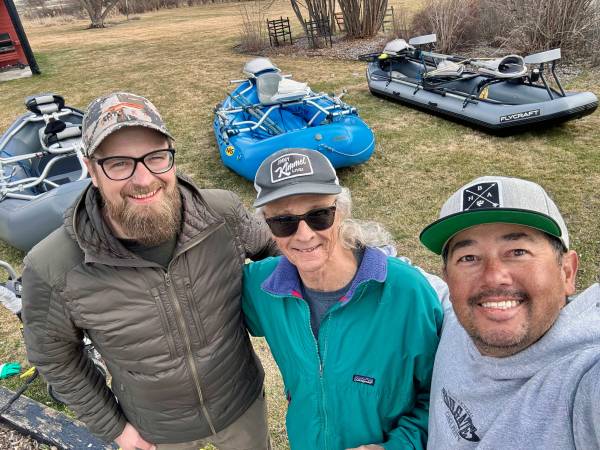
I first met Andy in 2024.
We were introduced by a mutual friend, Drew. I showed up to that first meeting still recovering from a major accident: back brace, neck brace, walker, the whole “human hardware store” setup. Not exactly the look you’re going for when you’re trying to make a good first impression.
But I already had an impression of Andy before we even shook hands. I’d done what everybody does now: some late-night internet research on a local legend. I knew the Purple Haze story. I knew the reputation. I knew I was meeting one of those guys.
What I didn’t expect was how fast we clicked.
Somehow, within minutes, this Bitterroot icon turned into a friend. Then a mentor. Then, pretty quickly, what I can only describe as a walking encyclopedia of Bitterroot history going back to the 1970s, including the behind-the-scenes legal battles over this watershed and its fishery.
Andy Carlson isn’t just the “Purple Haze guy,” either. He’s been outfitting, guiding, tying, teaching, and pushing for conservation in Montana for decades, shaping not only how people fish the Bitterroot, but how they think about fishing it.
The Bitterroot Valley as a Workshop (and Andy as the guy running the class)
The first time we actually fished together was mid-April, on a Bitterroot float trip with my wife, Nicole, along for the ride.
And it was one of those days the Bitterroot occasionally blesses you with: good light, good water, and fish that seemed interested in eating instead of judging you.
It was a Skwala day… and, yes, a Purple Haze day too. Because if you fish the Bitterroot long enough, you eventually accept that the Purple Haze is less a fly and more a dependable law of nature. You can fight it, or you can just catch trout.
If you’ve ever wondered what it feels like to fish with Andy Carlson, it’s basically this:
- Your drift is normal.
- Your fly looks fine.
- Andy makes one cast and somehow his looks more correct.
Andy is a casting master. His presentation is perfect most of the time, and his reach casting is the kind of style you can’t really copy from a video. It’s built from decades of repetition and an almost unreasonable level of control.
And because Andy is Andy, there’s always commentary.
Whenever I call him, the greeting is usually “Yo Ty!”
That morphed into “Captain Typhoon” in recent months. (I didn’t apply for the promotion, but I accepted the title.)
And then there’s the Andy-ism you’ll hear a lot once you’re in his orbit:
“Boom Shaka Laka.”
However it’s spelled, it basically means the same thing every time: that worked.
How the Purple Haze Happened (and why it took over the West)
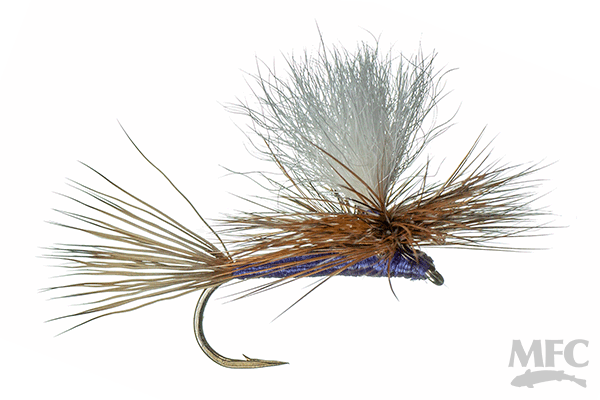
The Purple Haze is one of the most influential Western dry flies of the last 25 years, and it’s widely credited to Andy Carlson.
There are different published dates floating around online for when the Purple Haze first appeared, which is where much of the confusion around its origin comes from.
Here’s the part of the story that often gets missed.
Andy didn’t invent the Purple Haze in Montana.
He invented it in Wanaka, New Zealand, in 1999.
Like a lot of good ideas in fly fishing, it came from time on unfamiliar water, watching different trout, different light, and different insects, and realizing that a familiar silhouette needed a subtle but meaningful change.
At its core, the Purple Haze is a smart evolution of the Parachute Adams. It keeps the same proven profile and posture, but the purple body adds a darker, more versatile presence that trout respond to across a wide range of conditions.
Andy brought the fly back with him to the Bitterroot Valley, where it quietly proved itself on Western trout before the rest of the fly-fishing world caught on.
What matters for the Bitterroot story is this:
The Purple Haze was born abroad, refined at home, and became a Western staple because it simply works.
And I’ll add something personal here, as someone who guides and fishes this valley constantly:
The Purple Haze is now one of the go-to flies on the majority my trips.
Somehow it just works.
Not because it perfectly matches one exact insect in one exact phase, but because it has that perfect “mayfly enough” silhouette and a profile trout trust.
If you ask me what the Purple Haze is, I’ll tell you this:
It’s a fly that makes you look smarter than you are.
“Guardian of the Bitterroot” Energy (without the ego)
Andy’s reputation isn’t built on “look what I invented.” It’s built on a long career of being involved in the river’s health, access, and fishery quality.
Across profiles and interviews, the through-line is consistent: Andy isn’t just running trips. He’s part of the river’s modern identity.
Friends and peers: how Andy is perceived
Talk to enough people around Western Montana fly fishing and a few themes show up over and over.
1) He’s a teacher first
Even experienced anglers mention that you don’t really “just fish” with Andy, you learn.
And when Andy teaches, don’t expect the watered-down version.
If you’re on the river with him and you ask, “What kind of bug is that?”
You’re not getting the common name.
You’re getting the Latin name, followed by a dissertation about the insect’s life cycle, behavior, river timing, and why trout treat it like a religious event.
Each one could be its own article.
And honestly, that’s part of why I love this kooky guy.
2) He’s influential behind the scenes
Andy has trained many successful guides in Western Montana, which is how rivers build their culture: one guide teaches another guide, who teaches another guide, and suddenly half the drift boats on the river share the same fundamentals.
3) He’s respected in conservation and advocacy
Andy’s story is tied into the conservation and river-protection world that shaped modern Montana fly fishing.
Guiding and outfitting: the long-game mindset
Andy’s guiding style is built around making people better anglers, not just getting them fish for a photo.
He treats people the same whether they’re a total beginner or a seasoned vet. Same standards. Same intensity. Same “we’re doing this right” energy.
Andy is also opinionated, and he will absolutely let you know when you’re not doing something the Andy Way.
Some people don’t vibe with that. Some people misunderstand it.
I’ll be honest: Andy isn’t the most universally popular guy in town. And I get why, on the surface. He can come in hot. He can be blunt. He can be extremely sure of himself.
But once you get past the first layer, you realize something important:
He’s the kind of friend who would go to the ends of the earth for you.
He’s always looking out for your best interests, even if the delivery shows up wrapped in a debate.
Which brings me to one of the most “Andy and Ty” parts of our friendship.
We’ve sat down for deep conversations that frequently turn into full-on arguments. The kind of debates that would leave a lot of people frustrated, bordering on pissed. We don’t agree on everything, and we both know it.
But weirdly, I think we thrive on that kind of conversation.
Because at the end of it, we give each other a hug, say “Love you buddy,” and gear up for the next one.
That’s the long-game mindset, too. Not just in fishing, but in friendship.
The moment I realized Andy still surprises the river
One of my favorite days with Andy wasn’t about teaching, or debate, or even fly design.
It was about a single fish.
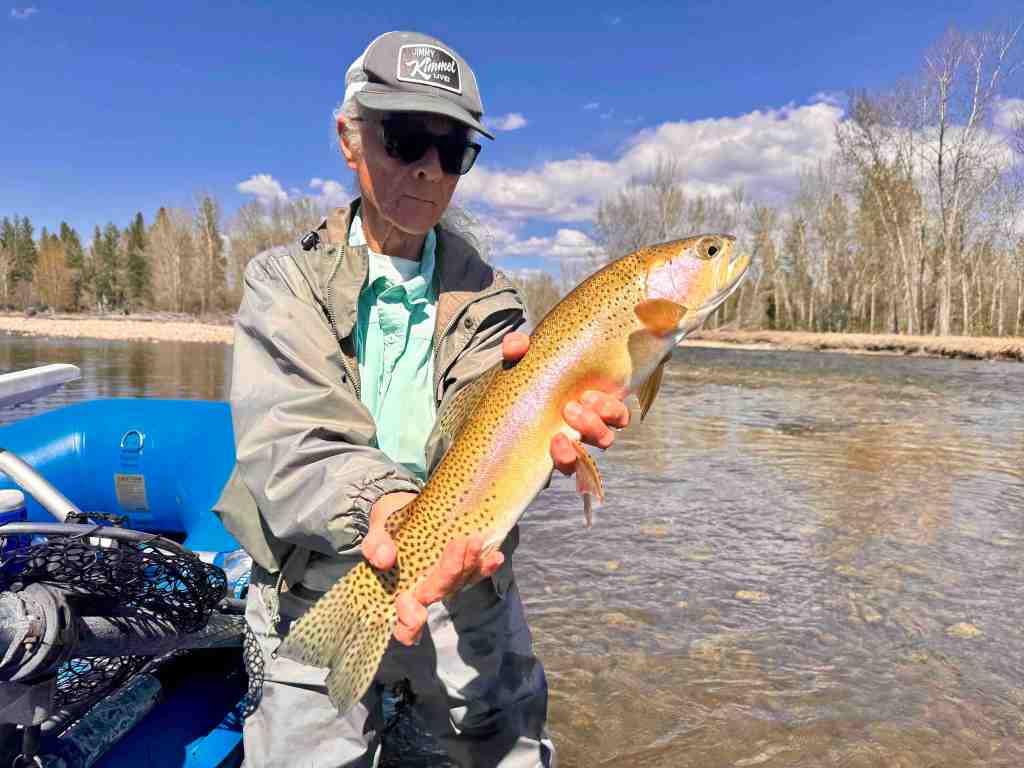
I was lucky enough to be on the oars the day Andy caught what he called the biggest cutthroat he’d caught in three years.
A 24-inch monster holding in a tiny bucket pool that didn’t look like it could hide anything bigger than a sandwich.
That’s the thing about great anglers: they see water differently.
Most of us look at a spot like that and think, “Maybe a 14-inch fish if I get lucky.”
Andy looks at it and thinks, “There’s a big one living in there.”
And then he proves it.
Fly tying with Andy: efficiency, choreography, and the quiet details
Andy is also one of the smartest people you could ever expect to meet when it comes to fishing and fly tying.
He has his own way of doing things, developed over decades.
I’ve been fortunate enough to sit down with him for a few fly tying lessons, and I’ll say this: watching Andy tie isn’t casual. It’s like watching someone who has turned every movement into muscle memory.
Every move is choreographed.
Saving a few seconds here or there on each fly.
Small tips. Small tricks. Small details that separate “just another fly” from something that looks alive.
In a world overflowing with patterns and options, Andy’s flies stand out because they’re built with purpose, not noise.
More than one fly: Andy’s deeper pattern library
The Purple Haze may be the fly that made Andy famous, but it’s far from the only pattern to come off his vise.
Like most truly good fly tiers, Andy never set out to invent flies for the sake of invention. His patterns exist because a river problem demanded a solution.
Over the years, Andy has developed and refined a number of effective nymphs, dries, and variations that quietly circulate among guides and serious anglers. These are the kinds of flies that don’t always show up with flashy names or marketing campaigns, but they show up when it matters: on tough days, pressured water, and selective fish.
Many of Andy’s patterns follow the same philosophy as the Purple Haze:
- simple silhouettes
- efficient materials
- durability
- and proportions that make sense to trout, not catalogs
They’re guide flies in the purest sense. Tools. Not decorations.
Nicole’s Golden: a fly tied with intention
One of the most meaningful flies Andy has ever tied, at least to me, isn’t a famous pattern at all.
It’s called Nicole’s Golden.
Andy tied it in honor of my wife, Nicole, and like most things Andy does, it wasn’t done casually or as a novelty. It was done with intention.
I’ve also come to suspect this fly may explain why Andy continues to put up with me.
If I’m being honest, I think the main reason Andy remains my friend is because he likes my wife more. And frankly, that’s fair. Nicole is calm, kind, and significantly easier to deal with on a boat than I am.
Nicole’s Golden is rooted in the same thoughtful approach that defines Andy’s tying style: clean lines, careful proportions, and a deep understanding of what trout actually respond to. It’s a fly built to fish, not just to be talked about.
What makes it special isn’t just how it performs in the water. It’s what it represents.
A moment. A relationship. A shared day on the river.
In fly fishing, some patterns become famous. Others become personal.
Nicole’s Golden falls firmly into that second category, and it’s one of the quiet reminders that Andy’s legacy isn’t just measured in patterns sold or articles written, but in the connections he makes with the people around him.
Trust on and off the river
There’s another layer to my relationship with Andy that matters, and it’s not something you hand out casually in this business.
Andy put his trust in me as a business partner.
He made me his booking agent, giving me the responsibility and authority to book fly fishing trips under his outfitter license. If you know anything about outfitting, guiding, or the regulatory landscape in Montana, you know exactly how significant that is.
What makes that trust even more meaningful is that Andy and I come from very different operating systems.
Andy is unapologetically old school.
He likes handwritten invoices. He writes checks. Paper gets stacked. Pens matter. If something can be done with a notebook, a calculator, and decades of experience, that’s usually his preferred route.
I, on the other hand, lean hard toward the modern side of things.
I like PDFs. Online payments. Digital booking systems. Clean workflows that let anglers focus on fishing instead of paperwork.
Somehow, instead of clashing, those differences have become complementary.
Andy brings decades of river knowledge, relationships, and earned credibility. I bring structure, digital tools, and systems that help keep the operation moving smoothly in a modern world.
That balance only works when there’s real trust on both sides.
Andy doesn’t hand the keys to his legacy to just anyone.
For me, that trust is one of the highest compliments I’ve ever been given in this sport. It says more than any endorsement ever could.
The Carlson legacy: not just fish, but people
If you zoom out, Andy Carlson’s impact isn’t only measured in trout caught. It’s measured in:
- guides he trained
- anglers he taught
- conservation fights he supported
- and a fly that became a Western standard
Andy has handed me literal reams of paper documenting the history and legal battles over the Bitterroot watershed and fishery.
I don’t think most people realize how much influence he’s had in this valley, not just on the water, but in the parts of the story that don’t make the Instagram reel.
The Purple Haze might be what gets people to click… but the Andy Carlson story is what keeps them reading.
The kind of guy you want in your river’s story
Every legendary river has characters. Some are loud. Some are brands. Some are myths.
Andy Carlson is different. He’s the kind of figure that’s quietly stitched into the Bitterroot’s modern identity: guide, tier, advocate, teacher, and someone whose name carries weight with people who actually know what they’re talking about.
Or to put it in Bitterroot terms:
Andy is the guy who doesn’t just fish the river. He helped shape what the river is today.
And as Andy would say after one of our long conversations:
Thanks for the chinwag.
 Bitterroot Retreat And Adventures