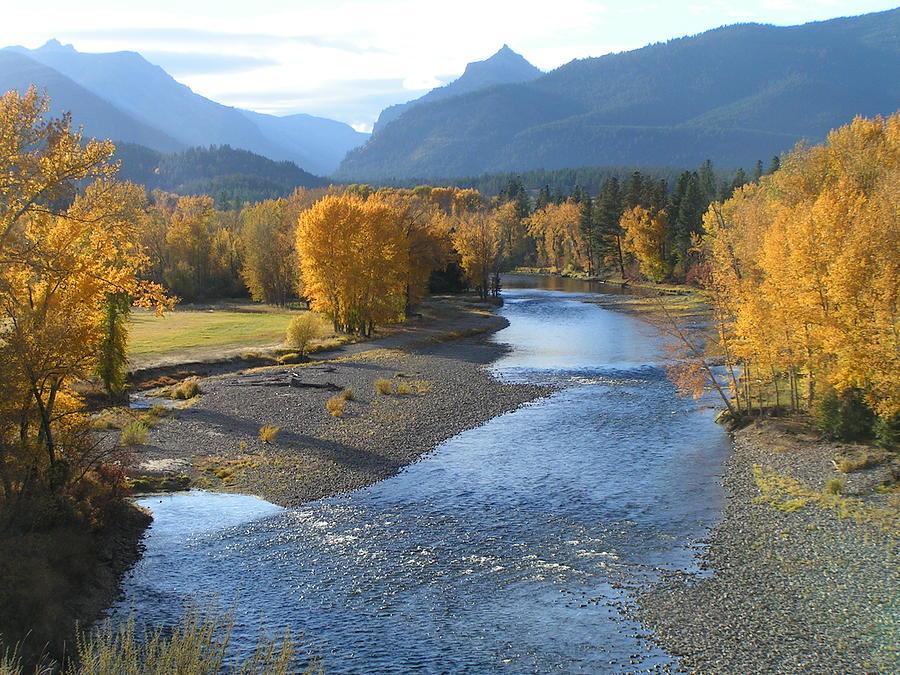
Autumn on the Bitterroot River in Montana, where golden cottonwoods line the banks beneath the Bitterroot Range.
Morning mist drifts above the Bitterroot River as it winds through a broad valley flanked by the Sapphire and Bitterroot Mountains. This iconic western Montana stream runs roughly 84 miles north from its headwater forks near Conner to its confluence with the Clark Fork River at Missoula. For centuries, people have been drawn to these waters – first for sustenance and spiritual nourishment, and later for sport and solace. The river’s story is one of Indigenous stewardship, pioneer ambition, angling tradition, and modern conservation, all etched into its riffles and pools. By exploring the Bitterroot’s fishing history – from Salish spear-fishing to the rise of fly rods and “hoot-owl” closures – we discover a river that captures the legacy and magic of Montana, leaving visitors yearning to cast a line in its currents.
Indigenous Stewardship and Traditional Fishing Practices
Long before any fly fisher cast a line on the Bitterroot, the Salish people (often called the Bitterroot Salish or Flathead) and their Pend d’Oreille and Kootenai neighbors cared for these lands and waters. The valley was the historical homeland of the Salish and Pend d’Oreille tribes, who knew the river intimately. They called the valley “Spet-lum,” meaning “place of the bitterroot,” in honor of the bitterroot plant that provided an important food source each spring. The Salish followed a seasonal round of harvesting and hunting: digging bitterroot roots at winter’s end, gathering camas bulbs in summer, and picking huckleberries and chokecherries in fall – all while hunting game like elk and bison and fishing the Bitterroot’s clear waters. Using bone hooks, spears, traps, and intimate ecological knowledge, they caught native westslope cutthroat trout, bull trout (a native char), and mountain whitefish to supplement their diet. These fish were more than calories; they were part of the Salish culture and survival in a place they managed with respect.
The Salish were not alone in valuing the Bitterroot’s bounty. Neighboring tribes, such as the Nez Perce, Pend d’Oreille, and Shoshone, would visit the valley to dig bitterroots and trade, introducing the Salish to horses in the 1700s. The river’s rich fisheries and game drew these Indigenous peoples into cooperative use of the land. For countless generations before Euro-American contact, Indigenous communities maintained the Bitterroot Valley’s ecological balance through their seasonal migrations and sustainable harvests. This deep connection is still remembered today – the Confederated Salish and Kootenai Tribes retain treaty rights to hunt and fish in the Bitterroot, and they co-manage water and fisheries resources in the region as part of their ancestral claim. The Bitterroot’s wild trout are, as one Montana angler-conservationist put it, “symbols of thousands of generations of indigenous culture”. This legacy of stewardship set the stage for all that followed on the Bitterroot River.
Exploration, Treaties, and Early Settlement
In September 1805, the outside world arrived in the Bitterroot Valley in the form of the Lewis and Clark Expedition. Weakened from a harrowing crossing of the Bitterroot Mountains, Captain Meriwether Lewis and William Clark’s Corps of Discovery emerged near present-day Lolo and were welcomed by the Salish. The Salish allowed the explorers to camp at a site now known as Traveler’s Rest, just south of Missoula, in 1805. Lewis and Clark rested, replenished, and noted the valley’s abundance of wildlife. Clark described a “handsome valley” about 5–6 miles wide with a river running through it, surrounded by towering peaks – an encouraging sight after the starvation of the mountains. Though not explicitly recorded fishing the Bitterroot, the expedition traded for provisions and undoubtedly recognized the river’s potential as they continued west. On their return journey in 1806, Lewis and Clark again stopped in the Bitterroot, testament to its strategic and nourishing location.
Missionaries and fur traders followed in the explorers’ footsteps. In 1841, Jesuit missionary Father Pierre-Jean DeSmet established St. Mary’s Mission at modern Stevensville – the first permanent Euro-American settlement in Montana. The mission introduced irrigation and agriculture to the valley; the very first hand-dug irrigation ditches in Montana were cut here to water mission gardens and grain fields. By 1850, Major John Owen set up Fort Owen, a trading post near Stevensville, which became a hub for trade with local tribes and incoming settlers. The Bitterroot’s fertile soil and abundant water drew a trickle of homesteaders (the first American settlers arrived around 1855), who planted crops and raised livestock along the river. Inevitably, conflicts arose over resources: one of Montana’s first court-recorded water rights disputes occurred here in the 1880s, after a deadly fight broke out over diverting water from a Bitterroot tributary. The concept of legally protecting water for irrigation was born of such conflicts, foreshadowing future battles between irrigation and fisheries.
This influx of outsiders and their farms had dire consequences for the Salish and other tribes. The Hellgate Treaty of 1855, negotiated by Territorial Governor Isaac Stevens, pressed the Flathead (Salish) to relinquish the Bitterroot Valley and move to a reservation in the Jocko (Flathead) Valley north of Missoula. Salish Chief Victor initially refused to abandon the Bitterroot, and for decades the Salish remained in their beloved “Spet-lum” despite treaty terms. It was only in 1891, after Chief Victor’s death and under mounting pressure, that Chief Charlo (“Little Shell”) led the final band of Bitterroot Salish out of the valley. Faced with a dismal drought, the disappearance of bison, and constant harassment by the U.S. Army, Charlo agreed in 1889 to relocate his people 60 miles north to the Flathead Reservation. Their departure – a sorrowful march out of the valley – marked the end of thousands of years of Indigenous residence in the Bitterroot. As they left, the settler population and development in the valley surged, and the Bitterroot River’s next chapter began.
Irrigation, Development, and Changing River (1880s–1930s)
By the late 19th century, the Bitterroot Valley was transforming into an agricultural hub for the new state of Montana. Copper King Marcus Daly, a wealthy mine owner from Butte, arrived in the 1880s and profoundly altered the valley’s fate. Daly built a sawmill and founded the town of Hamilton in 1890 to support his mining operations, but he also recognized the valley’s farming potential. He envisioned the Bitterroot as a “breadbasket” that could feed the booming mining towns of Butte and Anaconda, and he invested in irrigation on a grand scale. Daly’s agents and East Coast investors financed an elaborate network of ditches and canals known as the Bitter Root Irrigation Project, or colloquially the “Big Ditch.” From 1906 to 1915, crews constructed some 56 miles of main canal and many more miles of laterals, diverting water from the Bitterroot River and its tributaries to arid benchlands on the valley’s east side. Lake Como, a natural mountain lake, was enlarged with a dam in 1909 to serve as a reservoir feeding the Big Ditch, and diversions from creeks like Lost Horse Creek supplemented the flow.
This massive irrigation scheme set off an “Apple Boom” land rush. Slick salesmen back East advertised the Bitterroot as an irrigated Eden perfect for apple orchards. Thousands of would-be orchardists bought plots, and Hamilton’s population nearly doubled from 1,800 to 3,000 between 1907 and 1911 amid the hype. For a few optimistic years, the Bitterroot was blanketed in apple blossoms and real estate speculation. But the dream outpaced reality: after Marcus Daly’s death in 1900, the irrigation company struggled with debt and mismanagement. Bitter winters (and perhaps the limits of what the land could produce) caught up with the newcomers. By 1915 the apple bubble had burst – many orchards failed, the Big Ditch company went bankrupt in 1917, and disillusioned farmers moved away in droves. What remained was an extensive irrigation infrastructure and a community that would turn to more traditional agriculture (hay, grain, dairy, timber) to survive.
The impact of these irrigation projects on the Bitterroot River was significant. Water that once stayed in-stream now flowed down ditches to alfalfa fields. Late each summer, the river ran low and warm as irrigators pulled their shares, straining fish habitat. To mitigate this, additional storage reservoirs were built in the mountains to release water during dry months. Dozens of small dams were constructed on tributary creeks, many high in the Bitterroot Mountains, to capture spring snowmelt for late-season use. Two large impoundments anchor the system: Painted Rocks Reservoir on the West Fork (completed in 1939) stores about 31,700 acre-feet, and Lake Como (expanded by dam in 1910) holds around 35,100 acre-feet. Together these projects irrigate approximately 110,000 acres of farmland in the Bitterroot Valley. Notably, modern agreements reserve a portion of this stored water for instream flows – Montana Fish, Wildlife & Parks (FWP) can release water from Painted Rocks and Como in late summer specifically to boost the Bitterroot’s flow and cool down the river for trout. This practice, unheard of a century ago, reflects a growing recognition that the river needs water as much as the fields do.
Beyond irrigation, the early 20th century brought other environmental changes. Vast Ponderosa pine forests that once covered the valley floor were logged aggressively. The Bitterroot River itself was used as a “giant conveyor” to float logs downstream, scouring banks and altering channels. Sawmills and splash dams likely dumped sediment and debris into the water, affecting spawning gravels for trout. Mining, too, left its mark: although the Bitterroot was not a mining center like some Montana watersheds, small gold and copper mines in the hills (at places like Eight Mile Creek and Big Creek) contributed heavy metal pollution that would later require cleanup. By the 1930s, the Bitterroot River was a changed river – its flow regimented by dams and ditches, its banks cleared in places of timber, and its waters carrying the impacts of development.
How did these changes affect the fishing? Early settlers certainly fished the Bitterroot for food, as fresh trout and whitefish were a welcome supplement to frontier diets. But there were no catch limits or seasons in those days, and overharvest began to take a toll on the native trout. To “replenish” the river and create better sport fishing, authorities turned to stocking non-native species. By the early 1900s, rainbow trout (from the West Coast), brown trout (from Europe), and brook trout (an Eastern U.S. char) were all introduced to the Bitterroot watershed. These exotic trout took hold and bred in the wild. Today, the legacy of that era is evident: the Bitterroot supports a mix of native fish – westslope cutthroat, bull trout, whitefish, sculpins – and non-natives, including brook trout in the small creeks and abundant rainbow and brown trout throughout the main river. The rainbows and browns, in fact, now dominate many sections, especially the lower river, where introduced northern pike have also appeared (illegally introduced and of growing concern to fish managers).
The Rise of Fly Fishing Culture in the 20th Century
Through the first half of the 20th century, fishing on the Bitterroot slowly shifted from primarily subsistence and local use to a recreational pastime enjoyed by Montanans and visiting “sports” alike. The Northern Pacific railway had reached Missoula and Hamilton by the 1880s, making the Bitterroot accessible to outside anglers. Early accounts from the 1920s–30s describe local gentlemen taking horse and wagon trips up the West Fork to fish for wild cutthroat, as well as families camping on the river to catch trout and whitefish for the pan. Tackle and techniques were evolving during this period: a Bitterroot angler in 1920 might have used a split-bamboo fly rod or perhaps a simple bait-fishing setup. Flies like the classic Royal Coachman or wet flies would have been common, and many fishermen still kept most of their catch to eat.
After World War II, the popularity of fly fishing in Montana began to surge. Fiberglass fly rods and synthetic fly lines made casting more accessible to the average angler, and improved roads allowed Montanans from Butte, Helena, or Spokane to trailer over to the Bitterroot for a weekend fishing getaway. By the 1960s, the river had a modest reputation regionally as a quality trout stream – though it was somewhat overshadowed by the famous Big Blackfoot River just to the north and the storied Madison and Yellowstone Rivers elsewhere in Montana. Still, local Bitterroot anglers quietly enjoyed robust fishing for wild trout, aided by the low human population in the valley at the time.
A major turning point in Montana’s fishing history – one that affected the Bitterroot profoundly – came in 1974. In that year, Montana Fish & Game (now FWP) made the revolutionary decision to stop stocking hatchery trout in its rivers where wild trout populations could sustain themselves. This “wild trout” policy was prompted by research showing that hatchery introductions often hurt native trout survival. It “stunned anglers across the state and the nation,” but proved incredibly successful. Beginning in 1974, the Bitterroot River and its tributaries received no more stocking of catchable trout; management would rely on natural reproduction. The result was a renaissance of wild trout fisheries. In the Bitterroot and other rivers, wild trout numbers rebounded dramatically once hatchery competition and angler overharvest decreased. Montana created a world-renowned legacy of wild trout management, and anglers began flocking from all over the globe to fish these free-flowing, naturally sustaining trout streams. Nearly all of Montana’s famous trout rivers today – including the Bitterroot – are wild fisheries harboring stream-born, wily trout instead of hatchery clones. This approach, coupled with science-based habitat improvements, has made Montana a mecca for fly fishing and cemented the Bitterroot’s reputation as a river of quality trout.
Equally important was the change in angling ethics over this period. In the 1970s–80s, catch-and-release practices caught on rapidly among fly fishers. Many anglers released most or all of their trout, especially the native cutthroats, recognizing that those fish were more valuable alive and spawning than on a dinner plate. This cultural shift greatly reduced fishing mortality. As Montana Trout Unlimited notes, the acceptance of catch-and-release by anglers has been a key reason wild trout management succeeded so spectacularly. By the 1990s, it was common on the Bitterroot to see fishermen carefully wetting their hands before handling a trout and sliding it back into the water – a far cry from the stringers of fish carried home in earlier generations.
The late 20th century also saw an explosion of fly fishing innovation and activity on the Bitterroot River. Local fly shops sprang up in towns like Hamilton, Stevensville, and Missoula, and guiding became a growing industry. Dozens of professional outfitters and hundreds of licensed guides now work on the Bitterroot each season, rowing anglers down the river’s scenic reaches and vying for the best early-morning launch spots at popular Fishing Access Sites. In many ways, the Bitterroot has become Montana’s most “urban” trout stream – flowing right through the populated Missoula area – and yet it remains incredibly productive. Montana FWP estimates that the Bitterroot is the third-most heavily fished river in the state, behind only the much larger Bighorn and Madison rivers. Anglers log over 100,000 fishing days on the Bitterroot each year, a testament to its popularity. Remarkably, the river sustains this pressure, thanks to healthy habitat in its mountain tributaries and those forward-thinking management policies. One might not think such a modest-sized stream could handle so many anglers, but the Bitterroot’s wild trout have proven resilient.
Fly fishing on the Bitterroot is defined by its phenomenal hatches and seasonal rhythms, which have only grown in fame over time. Perhaps the most celebrated is the Skwala stonefly hatch of early spring. The Skwala is a small, olive-green stonefly that typically hatches in late February through March – when snow still blankets the banks. For Bitterroot anglers, Skwala time is a sacred opener to the fishing season. They know that even before any mayfly appears, they can tie on a big foam Skwala dry fly and coax large cutthroat and rainbow trout to the surface. It seems almost absurd – casting size 8 dry flies in snow flurries – but trout recognize this first big bug of the year and will rocket up 15 feet from the river bottom to grab a Skwala imitation. Fishing the Skwala hatch has become a point of pride (and patience) among local fly fishers; as one writer quipped, waving a fly rod in a snowstorm with no hatch in sight is “exactly this anomaly that makes the Bitterroot so iconic”. Along with Skwalas, the Bitterroot boasts excellent late spring hatches of March Browns and blue-winged olive mayflies that keep the action going until runoff.
Summer brings the classic Western trout cornucopia: salmonflies (giant orange stoneflies as big as your pinky) erupt usually in June on the upper Bitterroot and West Fork, providing a brief period of explosive action as 3-inch-long bugs splat onto the water and big trout smash them. Hot on their heels come the golden stoneflies (a bit smaller, bright yellow) and a parade of mayflies like Pale Morning Duns (PMDs) and Green Drakes in early summer. By July, caddisflies throng the evening air, and by late summer, when the hatches wane, grasshoppers, ants, and beetles – the terrestrial insects – become the go-to flies. Many a hefty brown trout has been fooled by a chernobyl ant or foam grasshopper drifted tight to the Bitterroot’s undercut banks in August. Summer is also float-fishing season: the river from Hamilton downstream offers gentle, meandering water perfect for drift boats, letting anglers cover miles of water and fish the thickets of log jams and deep outside bends where trout lurk. Guides love the Bitterroot because it “does it all” – it can challenge experts with technical dry-fly stalking one day, and delight novices with eager cutthroats on big dries the next.
As the heat of late summer gives way to autumn, the Bitterroot becomes, in many anglers’ eyes, pure magic. The crowds thin after Labor Day, the river cools down, and the trout ramp up their feeding in preparation for winter. Fall hatches of mayflies like the Mahogany Dun and tricos (tiny white-winged mayflies) speckle the water in September and October. On crisp mornings, you’ll find nose after nose of trout gently sipping Tricorythodes spinners in the eddies – a maddeningly delicate game for the fly fisher. (Indeed, “tiny tricos littering the backwaters… signal the beginning of fall, making a maddening challenge for the float-line fanatic,” as one account describes.) A #20 trico imitation and long, fine leader are needed to tempt those fish. Meanwhile, “anywhere there’s a brown trout there’s a bigger one” – the largest browns in the Bitterroot often show themselves in fall. These hook-jawed “kyped” browns, preparing to spawn, become aggressive and will slam larger offerings like streamers. An angler prospecting the deep pools with a sculpin or baitfish fly might hook the trout of the year on an autumn afternoon. Fall on the Bitterroot also means stunning scenery: the river’s cottonwood groves blaze yellow and orange, and snow dusts the high peaks. Floating or wading through this scene, casting to rising trout with no one else around, it’s easy to feel “a Salish-Jesuit prayer” in your heart for the finest fish and moments Montana can offer.
Winter months (November through early March) are the quiet season on the Bitterroot – but they are not devoid of fishing. Thanks to the influence of the dam-regulated West Fork, the Bitterroot mainstem stays relatively ice-free and fishable through the winter, unlike many Montana rivers. Trout metabolism slows in the cold; they pod up in deep, slow pools to conserve energy. A hardy local angler willing to brave freezing temperatures can sometimes entice trout with deep nymphing techniques or small midge dry flies on milder days. The takes are subtle and the fishing window is short (generally mid-day when temperatures peak), but the rewards include solitude and the river’s serene winter beauty – crystalline frazil ice along the banks, bare cottonwood limbs, and perhaps an eagle perched above a favorite trout hole. Many guides and serious anglers actually love this time, as they often have the Bitterroot completely to themselves. And come late February, as the days lengthen, everyone’s eyes turn to the water, watching for the first dark flutter of a Skwala – the promise that another fishing year is dawning on the Bitterroot.
Fishing the Bitterroot River Through the Seasons
To summarize the river’s seasonal personality, here’s a breakdown of how the Bitterroot fishes in each part of the year:
- Spring (March – May): Early spring on the Bitterroot can be legendary. By early March, the river awakens with the Skwala stonefly hatch – one of the earliest significant hatches in Montana. Even with snow still on the ground, trout eagerly rise to these size 8–10 stoneflies skittering across the water. Anglers cast big foam dry flies in olive or peacock colors, sometimes amid actual snow squalls, and can hook large cutthroat and rainbow trout that haven’t seen a fly in months. It’s a thrilling sight to see a 16-inch westslope cutthroat torpedo upward through frigid water to smash a Skwala dry. By April, mayfly hatches like March Browns join the fray, and the fishing remains excellent until runoff. Late spring (late April into May) brings the onset of mountain snowmelt. The Bitterroot often runs high, muddy, and unfishable in May as warm temperatures melt the Rockies’ snowpack. Many anglers either switch to the clearer West Fork (protected somewhat by Painted Rocks Dam) or wait out the “spring runoff” season. Spring is a time of feast or famine – when conditions line up, it’s some of the year’s best dry fly fishing, but Mother Nature often intervenes with floods.
- Summer (June – August): In a typical year, the Bitterroot’s flows peak in late May or early June and then drop into good shape by mid-to-late June. Early summer (June, early July) is prime time – water levels are dropping and clearing, trout are hungry from the high water period, and hatches are prolific. The fabled salmonfly hatch usually hits the upper Bitterroot and West Fork around late June. These giant orange-bellied stoneflies (think 3-inch insects!) send big trout into a frenzy. Floating the West Fork during the salmonfly emergence can yield explosive strikes on size 4 orange stimulators. Right on the salmonfly’s tail come the golden stoneflies, plus daily mayfly hatches such as Pale Morning Duns (PMDs) in late June and July. By mid-summer (July), the river’s flows are much lower and the weather hot. Trout seek oxygenated riffles and cooler tributary inflows. Hopper season kicks in – tossing a tan grasshopper pattern tight to a grassy bank on a July afternoon can be very effective, as terrestrials (hoppers, ants, beetles) become a big part of fish diets. Guides often run half-day trips, starting at dawn to take advantage of cooler water temps and better feeding. Late summer (August) brings challenging conditions: the Bitterroot can get warm (70°F+) on hot afternoons, which stresses trout. The state frequently issues “Hoot Owl” restrictions in mid-summer – no fishing after 2:00 pm – to protect trout when water temps climb too high. Anglers adjust by fishing early mornings and evenings, when water is coolest and trout are more active. Despite the heat, late summer can still produce good fishing, especially with hoppers in the afternoon and caddis or mayfly spinner falls in the evening. And if it rains or cools off, trout quickly rebound. Overall, summer offers the widest variety of fishing opportunities on the Bitterroot, from float fishing with attractor dries, to wet-wading the riffles with a hopper-dropper rig, to evening match-the-hatch dry fly tests.
- Fall (September – October): Ask local anglers their favorite time on the Bitterroot, and many will say the fall. By September, cooler nights bring the river back to life. Trout that sulked through August now feed with urgency in the comfortably cool water. Fall hatches might not be as massive as spring/summer, but they are consistent. Tricos (tiny mayflies, size 20–24) hatch on calm early fall mornings, creating pods of trout sipping gently – a true test of an angler’s finesse. Larger mayflies like Mahogany duns and Blue-Winged Olives (BWOs) also hatch in early to mid-fall, especially on cloudy days. Terrestrials (hoppers, ants) can remain effective through September until the first hard frosts. A unique fall highlight on the Bitterroot is the October caddis – a large orange caddisfly that appears in late September. Trout will slam an orange stimulator or caddis pattern during this hatch, providing great action on autumn afternoons. Furthermore, fall is streamer time for those hunting big browns. As brown trout approach spawning season (late October to November), the largest individuals become aggressive and territorial. Stripping a olive or black streamer through a deep pool in October might provoke a trophy brown to attack. Many of the Bitterroot’s largest trout are caught in fall by anglers willing to throw big streamers or patiently fish tiny dries – two very different methods. All the while, the scenery is breathtaking: snow often dusts the Bitterroot Range, the valleys glow with yellow cottonwood leaves, and elk bugles echo in the distance. With fewer anglers around, one can truly soak in the wild, lonely feel of the river in autumn. It’s no wonder many consider fall the Bitterroot’s most “aesthetically pleasing” season of all.
- Winter (November – February): Winter is the least popular season for fishing the Bitterroot, but it has its own quiet charm. After the frenzy of summer and the brilliance of fall, the river settles into a period of low, clear flows and icy serenity. Trout metabolism slows significantly in cold water – they won’t move far for food, so success comes by putting flies right on their noses. Nymphing deep runs with small beadhead nymphs (like a Pheasant Tail or midge larva) can pick up the occasional trout through December and January. There are also midday midge hatches on warmer afternoons, when clusters of tiny midges hatch and trout delicately sip them in slow pools. Only the most dedicated fly fishers usually pursue Bitterroot trout in winter, but those who do are treated to solitude and the beauty of a snow-draped river. Importantly, large sections of the Bitterroot remain open water in winter (especially downstream of warm tributary inflows or dam releases), whereas other regional rivers freeze over entirely. This means one could conceivably fly fish the Bitterroot in every month of the year – a fact that local anglers appreciate when cabin fever strikes. By late February, the cycle begins anew as the first Skwala stoneflies of the year often show up, heralding another season of abundance.
Each season on the Bitterroot has its own mood and magic. Together, they make the river a year-round fishery – something special in a place known for long, harsh winters. From the first cast of spring to the last quiet drift of winter, the Bitterroot always offers something to the observant angler.
Conservation Efforts, Modern Management, and Current Challenges
As the Bitterroot River’s popularity and usage have grown, so too have efforts to protect and manage it sustainably. The history of fishing here is not just about the past; it’s an ongoing story of conservation and challenges in the face of change. Today, multiple organizations and regulations work in concert to preserve the river’s health for future generations of fish and people.
One of the most significant conservation measures was the aforementioned shift to wild trout management in the 1970s. Ending the stocking of hatchery fish and trusting wild trout populations to replenish themselves was a bold step that has paid huge dividends. Along with that came more restrictive fishing regulations – for example, Montana gradually implemented catch-and-release or reduced creel limits on native westslope cutthroat trout (now a protected species in the Bitterroot) and imposed seasonal closures on spawning tributaries. Angler education campaigns in the 1980s and ’90s helped popularize ethical fishing practices like proper catch-and-release handling and using barbless hooks. Trout Unlimited (TU) and other local sportsmen’s groups have been active in the Bitterroot for decades, conducting stream habitat restoration, lobbying for flow protection, and monitoring fish populations. Thanks to collaborative efforts, nearly all of the Bitterroot’s trout fishery is now sustained by natural reproduction, indicating a healthy ecosystem (clean water and good habitat) underpinning the angling opportunity.
Maintaining water quality and quantity has been a key focus of modern management. With thousands of irrigation withdrawals, the Bitterroot in late summer can be a river of diminishing returns if not managed carefully. In 1999, recognizing that the river was over-appropriated, the state actually closed the Bitterroot Basin to any new surface water rights – an extraordinary measure to prevent further depletion of instream flows. Water users and fishery managers have since worked out agreements (like the Painted Rocks Drought Management Plan) to ensure that even in dry years, a minimum flow is released for the sake of trout downstream. During severe droughts, FWP can even make “water calls” using instream flow rights (some held jointly with the Salish-Kootenai Tribes) to temporarily curtail junior irrigation diversions and keep the river alive for fish. These are delicate balances between agricultural needs and ecological needs – balances that were often ignored in earlier days, but are front and center now.
Water temperature management has also become crucial. Trout are cold-water creatures; when river temperatures exceed about 70°F (21°C), the fish experience stress and can even die. In our era of climate change, Montana has seen a trend toward hotter, drier summers that drive water temps up and river levels down. Fisheries officials have responded with “Hoot Owl” restrictions, which prohibit fishing during the hottest parts of the day (typically 2 p.m. to midnight) once a certain temperature threshold is met (for the Bitterroot, usually when afternoon temps exceed ~73°F for three days). These restrictions, invoked in many recent summers, aim to reduce handling stress on trout that are already overheated. Anglers, for the most part, support and comply with these rules – a testament to increased awareness. As Montana Trout Unlimited notes, today’s anglers are more educated about the impacts of low, warm water than ever and willingly adjust their routines to protect the fish. For example, many guides will cancel or relocate trips if the Bitterroot gets too warm, and fly shops post daily temperature updates to encourage responsible fishing. Such community vigilance is now a part of Bitterroot river culture.
Despite these efforts, serious challenges remain. Drought and climate warming are perhaps the most ominous. The past decade has seen some of the lowest snowpacks and earliest runoffs on record in western Montana, and 2021–2022 brought exceptional drought conditions. Scientists have observed that spring runoff is peaking weeks earlier than it used to, and fire seasons (another indicator of heat and aridity) now extend into fall. In 2025, for instance, Montana entered drought emergency mode by June – stream flows in the region were as low as they’d normally be in mid-July. The Bitterroot was slightly better off than some rivers (running about two-thirds of its normal flow that June) only because managers could release extra water from Lake Como to prop up the river. But relying on stored water has limits. If warming trends continue, the Bitterroot’s trout will face increasingly frequent high-temperature stress and habitat contraction, especially in downstream reaches. Fisheries biologists warn that without adaptive management and perhaps even long-term changes (like restoring floodplains or increasing shading along streams), the Bitterroot’s wild trout could decline as their cold-water habitat shrinks.
Another ongoing challenge is development and land use change in the Bitterroot Valley. Since the 1970s, the once-rural valley has experienced waves of population growth. Missoula’s urban area has expanded southward, and many farms and ranches in the Bitterroot have been subdivided into housing. The valley’s population grew by an astonishing 40% during the late 1990s and early 2000s alone, as newcomers moved in seeking the clean air, open space, and mountain scenery. While that growth has benefits, it also puts pressure on the river. Subdivision development is termed “the greatest destroyer of wildlife habitat in the nation”, and the Bitterroot has not been immune. Construction near riverbanks can remove critical riparian vegetation (which prevents erosion and provides shade). More homes mean more wells and septic systems – in the Bitterroot’s case, many large rural subdivisions rely on septic tanks that can leach nutrients into groundwater and streams. Roads and paved surfaces contribute polluted runoff. And simply having more people around increases the likelihood of pollution incidents, litter, and disturbance to fish and spawning gravels (for example, from unmanaged river access or ATV crossings in streams). The Bitterroot River Protection Association and other local groups actively campaign for smarter growth policies – encouraging riverfront set-backs, preserving wetlands and side channels, and educating new residents about living responsibly in trout country. Some landowners have voluntarily established conservation easements along the Bitterroot and its tributaries, keeping those lands undeveloped forever, which helps protect the river corridor. Still, balancing development with conservation will be an ongoing test for the valley. As one report put it, “things are changing all around those towns” and sprawl has begun to creep across formerly open lands, bringing “more roads, more traffic, more garbage, more pollution” and fragmenting wildlife corridors. The community’s challenge is to accommodate growth without sacrificing the very natural qualities – clean water, abundant fish and wildlife, scenic beauty – that make the Bitterroot so attractive.
In facing these issues, the Bitterroot Valley benefits from an engaged community and a legacy of conservation. Montana has a strong stream access law that keeps rivers like the Bitterroot open to public use up to the high-water mark, which in turn fosters a sense that the river belongs to everyone – and that everyone shares responsibility for its care. Organizations like Trout Unlimited, the Bitterroot Chapter of Trout Unlimited, and the Bitterroot Water Forum have undertaken projects such as planting willows on eroding banks, improving irrigation diversions to be fish-friendly, and replacing culverts on spawning tributaries to allow migratory bull trout and cutthroat to pass. Federal agencies (U.S. Forest Service, U.S. Fish & Wildlife) are involved too, managing the vast public lands in the headwaters and funding habitat restoration (for example, removing old mining waste or decommissioning harmful roads in the Selway-Bitterroot Wilderness).
One illustrative success is the instream flow reservation: FWP holds rights to a certain amount of water from Painted Rocks Reservoir specifically for fish. In drought years, this water can be released to avert catastrophe for the trout. Such innovative tools are a result of decades of negotiation and science. Another success was preventing any further large dams on the Bitterroot. In the 1970s, there were proposals to build a new federal dam on the upper Bitterroot (to provide flood control and irrigation), but local residents, conservationists, and anglers united to oppose it, arguing the river needed to remain free-flowing. The project was eventually shelved, preserving the Bitterroot’s natural character. This spirit of advocacy continues; the Bitterroot River Protection Association today keeps a watchful eye for threats – whether they be pollution, unwise development, or attempts to chip away at stream access – acting as a river guardian on behalf of the public.
As we look at the current state of the Bitterroot River, it’s clear that each era of its fishing history is still present in some form. The Indigenous legacy persists in the very fish we catch – the westslope cutthroat trout, for instance, is a native species that sustained the Salish and is now cherished by modern anglers (and protected by law). Tribal representatives work with state officials on restoring and protecting these native fish, honoring a cultural link that goes back generations. The irrigation era left a mixed legacy: it enabled the community in the valley to grow, but also required new management strategies to make sure there’s enough water for fish. The sport fishing tradition, which took root in the 20th century, is now an economic pillar – fly fishing brings in significant tourism revenue to the Bitterroot Valley, supporting fly shops, outfitters, restaurants and hotels. That in turn creates political will to protect the river (people will fight to save what they value economically and recreationally). And the conservation ethos born in the late 20th century is now deeply ingrained. Anglers speak up in meetings about water rights and river regulations; “catch and release” and “leave no trace” are common slogans; even local schools incorporate river ecology and fly fishing into their curriculum, fostering the next generation of stewards.
In short, the Bitterroot is a river with a rich legacy and a vigilant community. It is not untouched by development or climate change – far from it – but it has proven resilient and adaptable. Its wild trout populations are a testament to both nature’s productivity and human restraint (in choosing wild fish management). As challenges like drought, warming, and growth intensify, the lessons learned here over the last century of fishing will be vital.
The Legacy and Magic of the Bitterroot
Stand on the Bitterroot’s banks today, and you can feel the layers of history swirling in the current. In one direction, you might imagine a band of Salish in a wide-brimmed tule hat, casting willow-root nets into a deep pool for trout, teaching their children the sacred relationship between the people and the river. In another, you might see the ghost of Meriwether Lewis, jotting in his journal about the valley’s beauty as curious Salish hunters look on. You might picture Marcus Daly’s workers furiously digging the Big Ditch, or a 1920s fly fisherman in tweed casting a cane rod by a Model T parked under a cottonwood. And you’ll certainly see today’s anglers: a couple in a drift boat laughing as they float through “the one you’ve seen in pictures” – that classic stretch between Hamilton and Victor with long riffles and towering cottonwoods – or a solitary wader releasing a brightly speckled cutthroat, his dog watching eagerly at his side. All these threads weave into the Bitterroot’s story.
What makes the Bitterroot River truly special is how it connects past and present, people and nature. The fish themselves are a living link. Some of those westslope cutthroat trout roaming the Bitterroot’s pools are direct descendants of the trout the Salish caught centuries ago – a lineage unbroken despite all the changes around them. Those wild trout, “symbols of thousands of generations”, deserve our care and respect. The Bitterroot’s fishing legacy has taught us that abundant trout don’t happen by accident; they are the result of wise management, habitat protection, and a community that treasures its river.
Anglers often speak of the “magic” of the Bitterroot, and it’s not just guide-book hyperbole. There is magic in a March afternoon when the clouds break, the sun warms the river just enough, and suddenly Skwalas are fluttering and cutthroat are rising with reckless abandon – and you realize you’re part of the age-old spring awakening of the valley. There’s magic in an evening hatch when you’ve tied the perfect size 18 Pale Evening Dun and fool that one elusive trout sipping under the branches, as the world goes silent and gold around you. There’s magic even in the hard times – in August when the river is low and the trout are sulking, and you volunteer to help an FWP crew rescue stranded fish from an irrigation ditch, giving literal breath to the phrase “save our trout”. The Bitterroot has a way of creating deep emotional bonds.
No wonder that anglers from around the globe, as well as local Montanans, speak of the Bitterroot with a blend of reverence and affection. It’s a river where you can feel the history – whether it’s casting a fly tied in the style of an old Salish fly (the Salish used downy feathers and bait on hooks, precursors to modern flies), or visiting the remains of Fort Owen after a day’s fishing to reflect on how far we’ve come in caring for this place. The Bitterroot invites you not just to catch fish, but to immerse yourself in a landscape and story much larger than yourself.
In the end, the history of fishing on the Bitterroot River is a hopeful one. It shows that rivers can endure and even thrive when people choose stewardship over exploitation. Today’s Bitterroot anglers inherit a river that still teems with wild trout, still runs free (mostly), and still hides pockets of solitude – thanks to those who fought to keep it that way. Challenges like drought and development test our commitment, but they also unite river lovers in common cause. As a result, the Bitterroot continues to be not only heavily fished, but heavily cherished.
For anyone who loves rivers, a visit to the Bitterroot is an immersion in the full spectrum of what a trout stream can mean: food and culture, sport and recreation, livelihood and inspiration. Watching an osprey plunge into a Bitterroot riffle and emerge with a wriggling trout, or wading into the river at sunset as the sky turns Bitterroot-pink (yes, the valley’s namesake flower paints the sky too) – these experiences stir something primal and profound. They make you understand why the Salish felt this valley was so sacred, and why fly fishers speak of it in almost spiritual terms. The Bitterroot River is more than just a place to catch fish; it’s a living museum of western Montana’s heritage and a classroom for how we can share natural resources across generations.
As one drifts around the next bend, the cottonwoods reflecting in the calm eddy, it’s easy to imagine the Bitterroot still looking much the same in another hundred years – if we continue to value its legacy and meet its challenges with care. Hopefully, future anglers will also find a river of plenty, where native cutthroat rise eagerly and the only crowds are the silhouettes of trout finning in the current. The story of fishing on the Bitterroot River is still being written, but one thing is certain: the Bitterroot’s magic will endure, as long as people remain as hooked on protecting this river as they are on fishing it.
Sources: Historical and cultural information about the Salish, Pend d’Oreille, and Kootenai tribes and their use of the Bitterroot Valley; early exploration and settlement data including Lewis and Clark’s visit in 1805 and the establishment of St. Mary’s Mission in 1841; details on treaties and the Salish relocation in 1891; development of irrigation and the Apple Boom drawn from Bitterroot Valley history accounts and Bureau of Reclamation records; information on dams, water storage, and irrigation impacts from Bitterroot River Protection Association archives; description of the river’s ecology, sections, and seasonal behavior from Montana fly-fishing guides and angling literature; documentation of the Bitterroot’s fish species (native and introduced) and current fisheries management from Montana FWP sources; statistics on fishing pressure and local population from recent articles; specifics on iconic hatches and fly fishing culture from fly-fishing magazine features; and insight on modern conservation measures (wild trout policy, hoot-owl restrictions, water rights) from Montana Trout Unlimited and news reports. All these pieces together paint a comprehensive picture of the Bitterroot River’s fishing legacy and its ongoing story.
 Bitterroot Retreat And Adventures
Leave a Reply